Tuesday, January 10, 2012

Sadako


During our winter break, we also paid a brief visit to Hiroshima.

From our hotel we took a streetcar to Peace Park, which is very near where I used to live.
Peace Memorial


Those of you who have read Sadako and the Thousand Paper Cranes by Eleanor Coerr are familiar with Sadako's story.  Here is her monument.  Those cases behind us are filled to the brim with paper cranes, just as they were when I lived here over twenty years ago.


In Peace Park, there is a museum about the bombing of Hiroshima and its effects.  We were amazed by this display of some of the actual cranes Sadako folded.  They are tiny, about the size of bumblebees.


Monday, January 9, 2012

Beauty School

Kaela and Tommy both take beginner Japanese at school instead of French or Spanish.  The high schoolers taking beginning Japanese went on a field trip to a local beauty school for a "cultural exchange."  Kaela had so much fun being dressed in a traditional kimono!


Saturday, January 7, 2012

Oosouji - "big cleaning"

In Japan, New Year's is also a time to spruce up, polish up, clean out, and clean up.  It is a time to clear out the clutter and dust from the old year, in order to start the new year fresh.  It is considered unlucky to ring in the New Year with clutter or dust from the old year.  It is also considered good luck to completely empty one drawer or closet shelf for the start of the New Year.  Lots of cleaning-related tasks happen in the weeks leading up to "oshogatsu" (New Year's).

When I came across these window washers last month, I couldn't help but imagine the excitement on the other side of the windows - this is an international preschool!   Can you imagine window washers suddenly appearing outside your classroom window at Russell Street?


Last month we had a "fire and pipe inspection" in the apartment.  Uniformed workers came to the apartment, and checked to see whether we were properly cleaning the bathroom drains (it's complicated and we wouldn't have known how to do it if a friend hadn't shown us!) and the kitchen sink drains (also somewhat complicated).  They also inspected our fire alarms and the hose from our washing machine.  They came in quietly and were in and out within five minutes, but it was nerve wracking!

Walking home from errands yesterday morning, I happened to come across our garbage collectors.  They pick up our garbage faithfully each Wednesday and Saturday, and we are grateful!  This was the first garbage pickup day in our neighborhood since the New Year's week when businesses were closed and services suspended, so there was more garbage than usual piled up along the streets in the neighborhood.


We follow very strict rules for recycling and garbage removal, and everything needs to be put out in clear bags (so that officials can check to make sure we aren't cheating!).  We have five (!) garbage cans/bags in our tiny kitchen, for:
1.  Regular garbage, which goes out twice a week.
2.  Miscellaneous plastics, including baggies, packaging, etc.  We are amazed at how much plastic we throw away!
3.  Paper products - also amazing how much paper we use and throw away!
4.  Cans/ glass bottles/PET bottles.   We further sort them into separate piles when we put them out for pickup.
5.  Unburnable garbage (old junk like a flower pot or a broken pair of scissors).
 
This makes recycling at the Transfer Station in Littleton seem like a piece of cake!


We refer to this chart to make sure we are doing the right thing: 


Friday, January 6, 2012

Kyoto, part two

While in Kyoto, we visited Ryooan-ji temple, which includes a very famous Zen rock garden.  There are fifteen rocks, but it is said that from any given position, you can see only fourteen of the rocks.  We counted and found that to be true.  To enter the garden, you pay a small fee, remove your shoes and put on plastic slippers they provide, and then try to find an open spot to quietly view the garden.  We felt very lucky that it wasn't too crowded.


The rocks and raked gravel are meant to symbolize either mountaintops peaking out of the mist, or islands in the ocean.  Most historians agree that the rocks were placed by a man named Soami around 1450.   It is Japan's most famous "hiri-niwa" (a flat garden, without hills or ponds).


Our favorite rock garden, though, was Kodaiji.  A guide explained that although the garden design is usually changed regularly, they decided to leave this design for the whole year, after the earthquake and tsunami.  This design depicts two dragons.  Dragons are said to be able to hold down, to calm, the earth.


For lunch one day we ate at a traditional noodle shop.  We took off our shoes, sat on the tatami (straw) floor, and we were definitely the only Westerners there!


From Kyoto we traveled to Hiroshima - stay tuned for photos of our time there!

Kyoto, part one


Noelle snapped this photo of an elusive Geisha in Kyoto


Over the winter break, we decided to travel a bit within Japan.  Noelle is with us, and it's great to be all together again for a few weeks.  Noelle took lots of pictures, some of which I am including here.

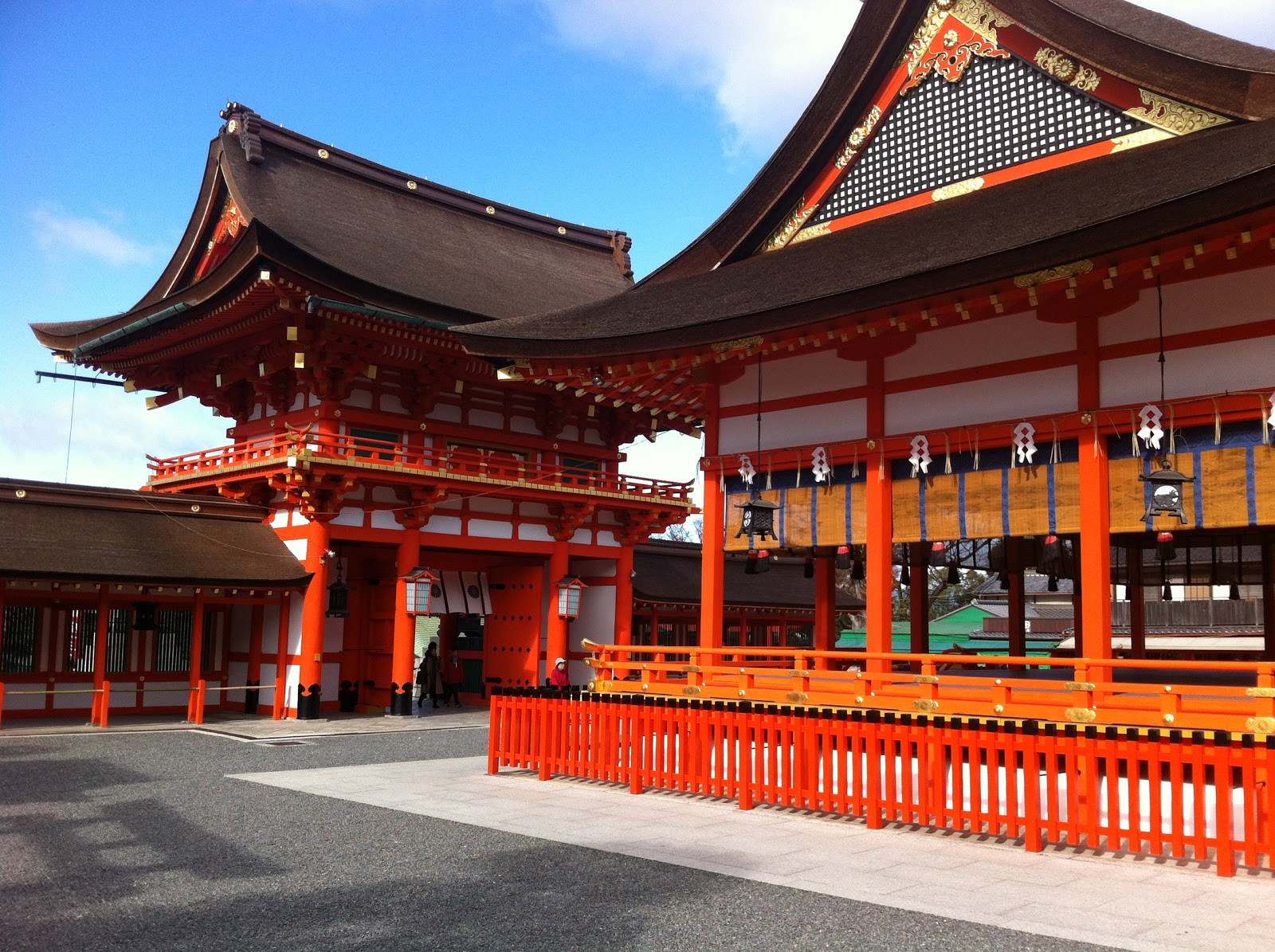
We traveled by bullet train, and spent a few days in Kyoto.  Kyoto was the ancient capital of Japan, and it is still the cultural center of Japan.  We had a great time.  We walked and walked, and saw lots of interesting shrines and temples.  Our first stop was Fushimi Inari Shrine. 

One giant Tori at the entrance gives a hint of what is to be found further up the incline.


If the fortune you receive is negative, leave it tied here and try again another time.


The fox is an important symbol in Japan.  This fox is holding corn - an important harvest symbol. 

Bamboo forest - it was magical!


Next we headed to Kiyomizu Dera.  Noelle snapped this photo of a spring where visitors drink the sacred waters.  There are three streams and it is considered greedy to drink from more than one.  But each spring represents different things, so people have to choose between luck in love, success in school, or a long life.  The line was so very long that we opted for none of the above!


We also visited Kinkakuji, the Golden Pavilion, one of the most famous sites in Kyoto. Noelle took some beautiful photos.


Amazing that at the end of December, there are still leaves on the trees!

The last of the persimmons are still clinging to their branches.


Happy New Year!


Happy New Year, Russell Street!  This photo shows a "kadomatsu" - a decoration that you see everywhere around New Year's here.  Some are fancier than others, but they all have two elements in common - Pine (which represents the "dwelling place" for the god that brings good luck),and Bamboo (which grows straight, representing consistency and integrity).  I had big plans for some great photos for this blog - but I waited too long!  I took a walk on New Year's Day, to take photos of all the various "Kadomatsu" in our neighborhood, but they had almost all been taken down already, right on schedule. 

New Year's is a very quiet at-home type of holiday in Japan, a time to gather with extended family.  People visit Shinto shrines and Buddhist temples, and they may travel very long distances to their home towns.  The trains are packed and travel is difficult at this time.  For 4 or 5 days virtually all businesses close.  Foreigners like us are advised to stock up on food and hunker down at home during this time - and so we did!  Our neighborhood felt like a ghost town for a few days.
 
While New Year's is a quiet family holiday here, Christmas is a secular "party" occasion for most Japanese.  It is mainly for couples, perhaps like Valentine's Day in the U.S.  However, we got a kick out of the fact that Christmas music - both secular and religious - was played in all the stores and train stations, throughout the month.  I hope I didn't receive too many strange looks as I sang along under my breath:).


We met this happy couple on Christmas Eve in Kyoto.  They are wearing their best "night on the town" traditional clothes.  I will post more photos from Kyoto soon!


Thursday, January 5, 2012

A visit to an orphanage

Last month, Kaela, Tommy, and I visited a Red Cross Hospital orphanage with our youth group. The teenagers presented a little program of songs, and then they had free time to play with the children.  There were lots giggles and photographs.


Only later did I learn that some of the adult helpers in the room were actually parents of the children.  I learned that in Japan, adoption is extremely rare, and so orphanages are much more common here than in the US.  Some children grow up in the orphanage, and others get "checked" in and out by the month or year, or whatever.  This seems shocking to us but it is very normal in Japan!